

RENATA Cybercop Wins Best Case Study at Bulgarian Security Summit Awards 2026
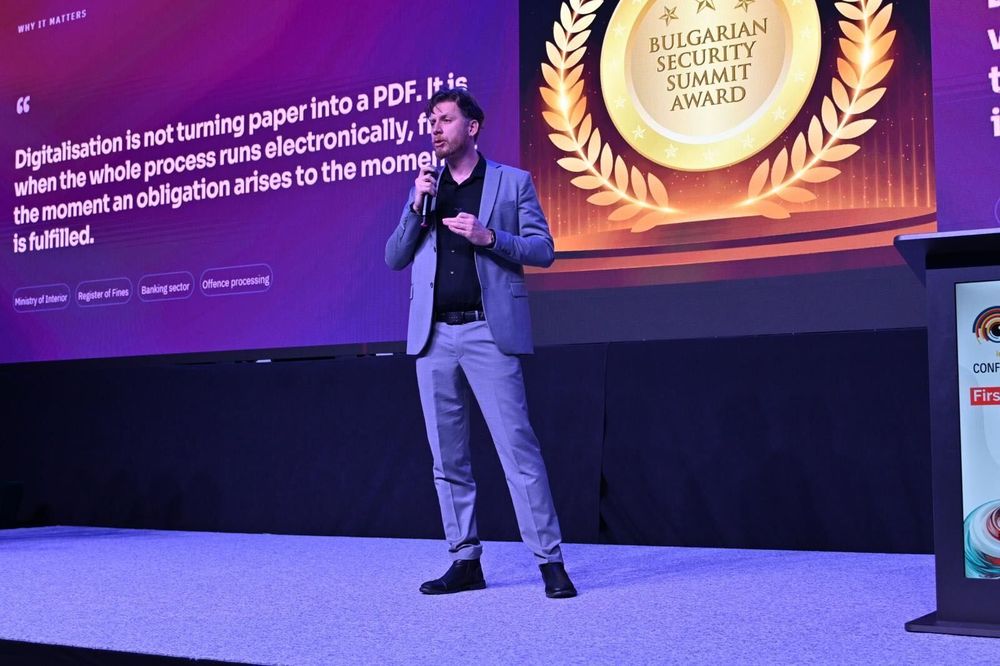
Our company, ITO, has received the Best Case Study award at the Bulgarian Security Summit Awards 2026 for its implementation of a fully digital traffic fine payment and processing system in Bosnia and Herzegovina. The recognition highlights how connecting public institutions, financial systems and administrative procedures can turn complex processes into simpler, more efficient digital services.
The award was presented on 29 October 2026 at the Bulgarian Security Summit in Sofia, an international gathering of security industry professionals, technology providers and institutional representatives. Winners were selected through an evaluation process involving an independent jury of regional and international security experts and a public vote.
For ITO, the award marks another international recognition of RENATA Cybercop, its law enforcement and public safety platform, and brings particular attention to a project that demonstrates the practical impact of digital transformation in public administration.
From Paper-Based Procedures to a Connected Digital Process
The award-winning project was implemented in cooperation with the Ministry of Interior of Herzegovina-Neretva Canton and introduces an end-to-end digital process for managing and paying traffic fines.
Traditionally, processing a traffic violation involved several separate administrative steps. Once a misdemeanour order was issued, citizens were required to complete payment procedures, while institutions relied on additional processes to verify transactions, update records and close cases.
The RENATA implementation connects these previously fragmented activities into a single digital workflow.
When a misdemeanour order is issued, it is recorded in RENATA and made available to the citizen through an online service. The fine can then be paid electronically through the banking system in Bosnia and Herzegovina. Once the transaction is completed, payment information is automatically recorded and reconciled with the corresponding case, enabling its closure without additional manual processing.
The result is a process that no longer depends on paper payment slips, visits to service counters or manual payment verification.
Crucially, the solution goes beyond introducing an online payment option. It connects the Ministry of Interior, the Register of Fines, banking infrastructure and offence processing into one coordinated digital chain.
Why This Project Matters
The significance of this implementation lies in addressing one of the most persistent challenges of public-sector digitalization: connecting systems and institutions that have traditionally operated independently.
Introducing a digital service is only one part of the transformation. For that service to deliver lasting value, the processes behind it must also be integrated, reliable and capable of exchanging information securely.
By automating the traffic fine lifecycle, RENATA reduces repetitive administrative work, limits the need for manual data entry and improves the consistency of records across connected systems.
For citizens, it means a more accessible and straightforward way to fulfil their obligations. For public institutions, it means more efficient processing, improved transparency and better control over administrative workflows.
The implementation in Herzegovina-Neretva Canton represents the first fully digital traffic fine lifecycle of its kind in Bosnia and Herzegovina, demonstrating how existing institutional processes can be modernized through interoperability rather than isolated technological solutions.
For a closer look at the implementation and its benefits for citizens and institutions, read our case study: Online Fine Payments: How Renata Is Transforming the Way Violations Are Managed.
A Third International Recognition for RENATA
The Best Case Study award in Sofia adds to RENATA Cybercop's record of international recognition.
The platform previously received the Best Case Study in Central and Eastern Europe award in 2017 and the Best Software Award in 2024 at a&s Adria summits.
The 2026 award is RENATA's third recognition within the a&s Adria summit ecosystem and its first at the Bulgarian Security Summit.
Developed by IT Odjel, RENATA supports the digital transformation of law enforcement and public safety institutions through integrated solutions for traffic enforcement, operational management, data exchange and administrative process automation.
Its modular architecture enables institutions to modernize individual processes while maintaining interoperability with existing systems and infrastructure.
The recognition in Sofia further demonstrates the relevance of solutions developed in Bosnia and Herzegovina to broader challenges facing public administration and security institutions across the region.
Recognition Built on Collaboration
Behind the technical achievement is a partnership between the institutions responsible for implementing change and the teams responsible for making that change operational.
Projects of this scale require more than software development. They depend on institutional cooperation, a willingness to redesign established procedures and a shared commitment to creating services that work more effectively for both citizens and public employees.
ITO extends its appreciation to the institutions and project partners whose cooperation made the implementation possible, as well as to the engineering and implementation teams supporting RENATA in everyday operations.
The company also thanks everyone who supported RENATA during the public voting process.
The Best Case Study award is not simply recognition of a technology. It recognises a working example of what becomes possible when institutions, processes and systems are successfully connected.
For ITO, that is also the central principle behind digital transformation: meaningful progress is measured not by the number of systems introduced, but by the improvements they deliver in practice.